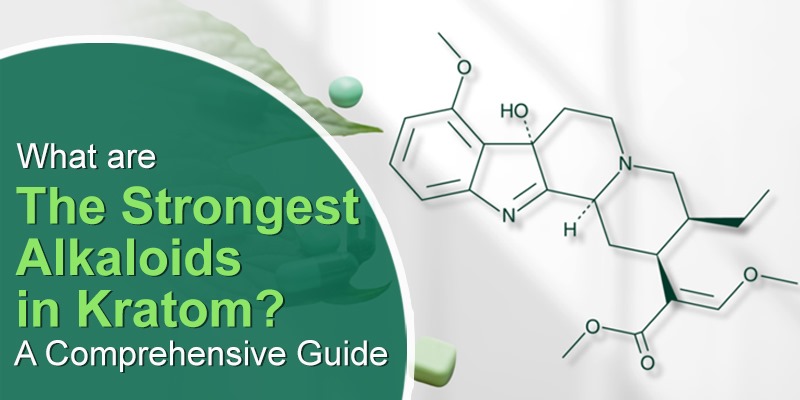
Alkaloids are organic compounds containing nitrogen and are found in plants, fungi, and bacteria. But, what is its relation to Kratom, also called Mitragyna speciosa? Alkaloids are found in Kratom and act as nicotine and caffeine. Likewise, it boosts mood and increases energy. Kratom is extracted from the jungles of Southeast Asia and it has gained popularity recently. Consequently, alkaloids in Kratom target the body receptors and produce several psychological effects such as relaxation, pain relief, etc. Among the long list of many alkaloids of kratom, mitragynine, and 7-hydroxy mitragynine are of great interest. This article comprehensively explains the Kratom alkaloids, their role, legal status, potential benefits, and risks.
What Alkaloids are in Kratom?
Kratom (Mitragyna speciosa) consists of almost 40 alkaloids, along with flavonoids, terpenoids, and other bioactive compounds that contribute to its unique effects. Among these, the most significant are mitragynine and 7-hydroxy mitragynine (7-OH-mitragynine). Here’s the Kratom alkaloid list:
| Alkaloid in Kratom | Function |
| Mitragynine | The most abundant.
Stimulant effect at low dose. Pain relief at high dose |
| 7-Hydroxymitragynine (7-OH-mitragynine) | 46 times more potent than mitragynine and 13 times stronger than morphine.
Strong analgesic and sedative effects. |
| Paynantheine | Smooth muscle relaxant |
| Speciogynine | Controls tension and discomfort |
| Speciociliatine | The Stereoisomer of mitragynine.
Acts mildly. |
| Corynantheidine (Rauhimebine) | Alpha-adrenergic antagonist.
Contributes to Kratom’s stimulant properties. |
| Corynoxine & Corynoxine B | Stimulates dopamine.
Supports Kratom’s mood-lifting quality |
| Ajmalicine | A vasodilator and anti-hypertensive compound.
Promotes anti-anxiety |
| Mitraphylline | Acts as an anti-inflammatory and immunostimulant. |
| Isomitraphylline | Contributes to anti-inflammatory effects. |
The Role of Alkaloids in Kratom
Alkaloids are naturally occurring chemical compounds that contain basic nitrogen. They are usually biologically active and have a great influence on the human system. Kratom in Alkaloids are the predominant compounds for kratom stimulating pain receptors within the brain and, therefore, their analgesic and mood-modifying activities. Let’s discuss the main Kratom alkaloids one by one.

Mitragynine: The Strongest Alkaloid in Kratom
Mitragynine is the most popular alkaloid in kratom and accounts for approximately 60-70% of alkaloid content. It is known as the major active ingredient which is attributed to most of kratom’s alkaloid effects. Mitragynine is a chemical drug that acts on sedative receptors in the brain but fails to activate them fully like typical morphine. The partial activation is thought to assist kratom in delivering pain relief and euphoria. It doesn’t fully remove respiratory depression.
Mitragynine is active in other receptor systems, including adrenergic, serotonergic, and dopaminergic receptors. The Kratom consumer describes its multi-mode activity as responsible for varied effects. It ranges from increased energy and concentration with low doses to sedation and analgesia with high doses. The ability of the alkaloid to modulate multiple neurotransmitter systems makes it a complex and versatile compound of therapeutic and recreational interest.
7-Hydroxymitragynine: A Potent but Less Abundant Alkaloid in Kratom
While mitragynine is the best-known alkaloid present in kratom, 7-hydroxy mitragynine is most commonly considered to be the most active. Likewise, this Kratom alkaloid is present in much smaller amounts, typically less than 2% of the total alkaloid. In addition, it has a greater affinity for pain receptors. 7-hydroxy mitragynine is estimated to be between 13-30 times more active than mitragynine. This renders it one of the main drivers of kratom’s analgesic and sedative effects, particularly at higher doses. While its potency, the low concentration of 7-hydroxy mitragynine in raw kratom leaves guarantees that its net contribution to the plant’s effects is less than that of mitragynine. 
Mitragynine and 7-Hydroxymitragynine Comparison
The combination of mitragynine and 7-hydroxy mitragynine is probably the most intriguing aspect of kratom pharmacology. While mitragynine is more abundant and is responsible for kratom’s action, the very high potency of 7-hydroxy mitragynine suggests that the latter alkaloid should not be dismissed in the overall effect of the plant. Furthermore, the combination of the two alkaloids in Kratom is only a way of proving the complexity of kratom’s chemical structure and the necessity of studying the plant as a sum of parts rather than considering particular compounds.
In addition, the action of kratom is variable by strain and dose. For instance, some strains of kratom are bred or processed to maximize specific alkaloid content. In the same way, it can affect their action. Thus, this variability makes it even more complicated to understand kratom’s pharmacology and therapeutic potential.
The Pharmacology of Kratom: Beyond Alkaloids
While mitragynine and 7-hydroxy mitragynine are the most well-researched of the kratom alkaloids, numerous other compounds in the plant are potentially responsible for its effect. Similarly, paynantheine, speciogynine, and speciociliatine are some of the lesser-researched but supposed ancillary actors in kratom pharmacology. Other Kratom compounds such as flavonoids, terpenoids, and other phytochemicals may have synergistic effects with the alkaloids.
The intricate chemical makeup of alkaloids in kratom makes it impossible to be certain about its effects. Metabolism, dosage, and mode of administration can all affect how kratom is broken down by the body. This is just one of many reasons kratom is such a contentious drug, and there are always arguments about whether kratom is safe, effective, and addictive.
Legal Status and Regulatory Challenges
The legal status of kratom is very different all over the world. In some countries, such as Thailand and Malaysia, kratom has traditional historical use and is legally controlled. In others, such as the United States, kratom is legal in limited states. Likewise, kratom is not a controlled substance at the federal level, but it has been prohibited or limited by multiple states and cities. The U.S. Food and Drug Administration (FDA) has issued warning letters about kratom because of concerns over safety and abuse potential. However, proponents think kratom can be a useful pain reliever.
The regulatory difficulty is directly related to the alkaloids in Kratom. Since mitragynine and 7-hydroxy mitragynine are active at opioid receptors, kratom is vulnerable to abuse or dependence. At the same time, the partial agonist effects of these alkaloids imply kratom has a reduced risk profile. It is this contradiction that has perplexed policymakers and hindered policy-making on kratom regulation.
Potential Benefits and Risks of Alkaloid in Kratom
Kratom alkaloids, especially mitragynine, have been the focus of many studies into their possible benefits and dangers. As a therapy, kratom has been marketed as a natural painkiller for chronic pain, anxiety, and depression. Similarly, most consumers attest that kratom brings relief without the harsh side effects of prescription drugs. However, with no strong clinical trials, the benefits are anecdotal and not yet supported by strong scientific data.
Although Kratom is not without risk, high doses may produce side effects such as nausea, dizziness, and constipation. Likewise, there have also been a few cases of more serious side effects, such as liver toxicity and seizures, although these are relatively rare. Dependence and withdrawal are also a possibility, particularly among those who regularly use kratom or in large amounts. In addition, as with any medication, the key to remaining safe is responsible consumption and a clear understanding of its effects.
Conclusion: The Complexity of Kratom’s Alkaloids
To sum up, mitragynine is indeed kratom’s most active and strongest alkaloid, but it is merely one piece of a complex puzzle. The interaction of mitragynine, 7-hydroxy mitragynine, and the other alkaloids creates a pharmacological profile that is still not fully comprehended. Similarly, as we learn more about alkaloids in kratom from scientists, we can understand more about how these compounds interact to produce the effects of the plant. Kratom’s potential as a medicine is captivating but also beset with significant issues. Hence, the regulatory and legal landscape is still uncertain, and more study needs to be done to fully understand its benefit and risk profile.
Frequently Asked Questions (FAQs)
What are alkaloids?
Alkaloids are the organic compounds found in plants, fungi, and bacteria. The compounds have psychological effects on human minds.
What are the two main Kratom alkaloids?
Mitragyna speciosa and 7-hydroxy mitragynine are the two main Kratom alkaloids.
Which one is the strongest alkaloid in Kratom?
7-hydroxy mitragynine is the strongest alkaloid in Kratom. It is 46 times stronger than mitragynine.